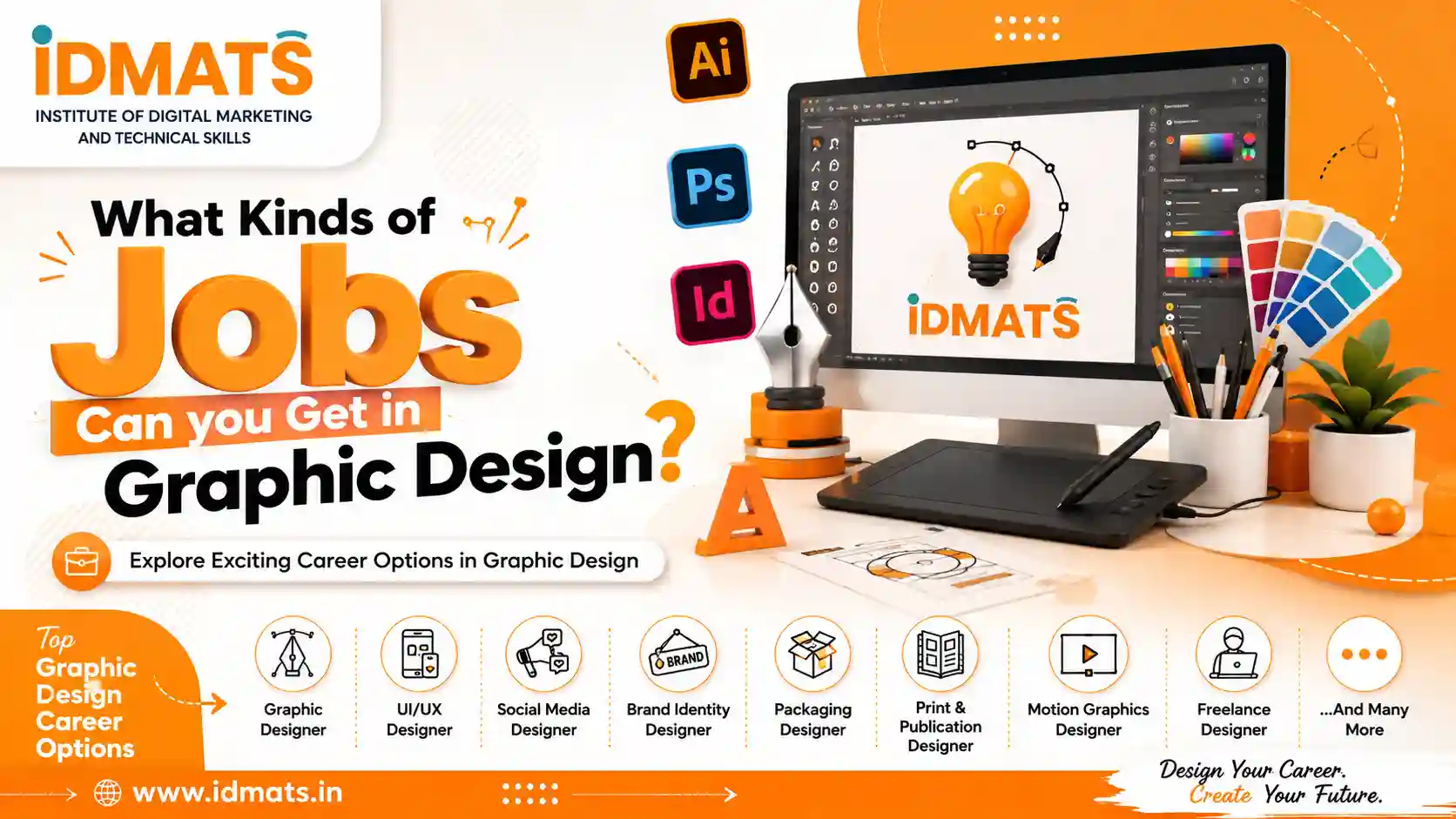
If you enjoy creativity, visual communication, colours, typography, layouts, and digital tools, graphic design can offer a wide range of career opportunities. You do not have to become only a “graphic designer”. With the right skills, you can work as a UI designer, brand designer, social media designer, packaging designer, motion graphics designer, visual designer, publication designer, or freelance graphic designer.
The best career option depends on your interests, design skills, software knowledge, portfolio, and the type of work you enjoy.
For students and beginners, graphic design is also a practical career because businesses across industries need visual content for websites, social media, advertising, packaging, presentations, apps, and branding.
Quick Overview: What Jobs Can You Get in Graphic Design?
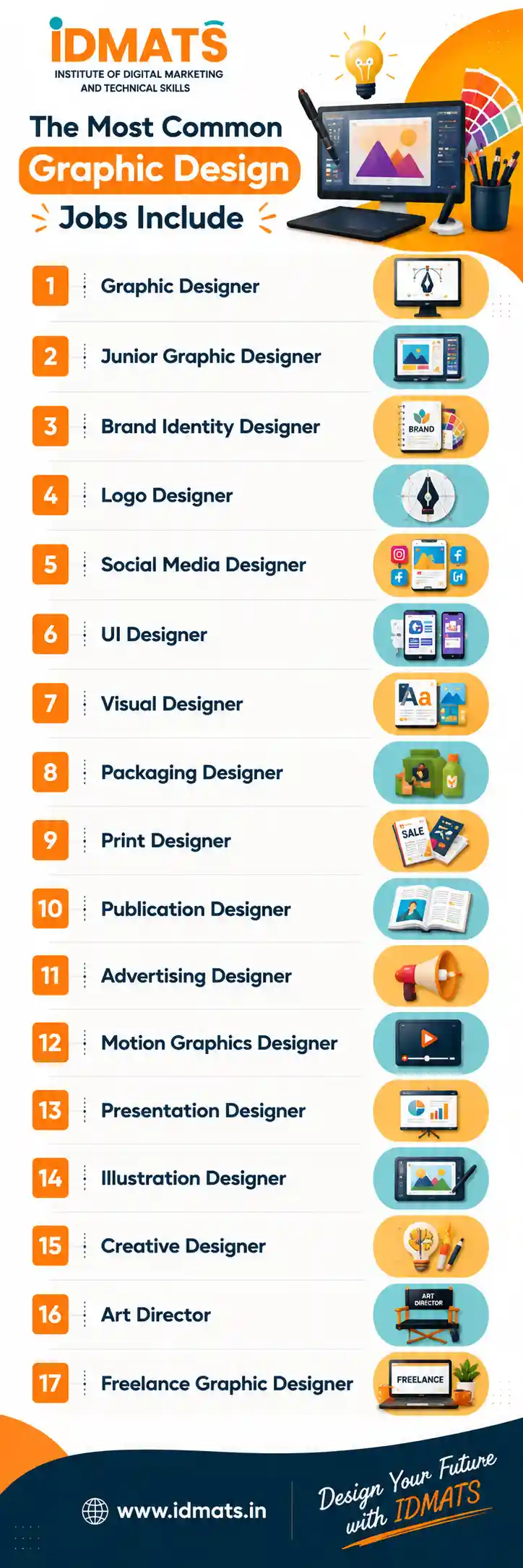
The most common graphic design jobs include:
Graphic Designer
Junior Graphic Designer
Brand Identity Designer
Logo Designer
Social Media Designer
UI Designer
Visual Designer
Packaging Designer
Print Designer
Publication Designer
Advertising Designer
Motion Graphics Designer
Presentation Designer
Illustration Designer
Creative Designer
Art Director
Freelance Graphic Designer
Some professionals also combine graphic design with UI/UX design, digital marketing, video editing, animation, web design, and content creation to access more career opportunities.
1. Graphic Designer
A graphic designer creates visual material that communicates a message clearly.
This is one of the most common career paths after learning graphic design.
A graphic designer may create:
Social media posts
Posters
Brochures
Banners
Advertisements
Presentations
Business cards
Website graphics
Marketing materials
Graphic designers can work in design agencies, advertising companies, marketing departments, publishing houses, e-commerce companies, startups, and other businesses.
2. Brand Identity Designer
A brand identity designer focuses on how a business looks and communicates visually.
The work can include:
Logo design
Colour palettes
Typography
Brand guidelines
Business stationery
Marketing templates
Packaging visuals
Brand assets
This role requires more than knowing design software. You need to understand how colours, fonts, shapes, images, and layouts work together to create a consistent brand identity.
3. Logo Designer
Logo designers specialise in creating logos that represent companies, products, organisations, and personal brands.
A good logo needs to be:
Simple
Recognisable
Relevant
Scalable
Easy to use across different platforms
Logo design can also be a useful freelance service because businesses regularly need new logos, redesigns, and brand updates.
4. Social Media Designer
Social media has created a large demand for designers who can create attractive content quickly.
A social media designer may create:
Instagram posts
Facebook creatives
LinkedIn graphics
YouTube thumbnails
Story designs
Promotional banners
Carousel posts
Campaign creatives
This role becomes even more valuable when a designer understands basic digital marketing, audience behaviour, content strategy, and social media advertising.
5. UI Designer
A UI designer works on the visual appearance of websites, mobile apps, and digital products.
Their work may include:
Website layouts
Mobile app screens
Buttons
Navigation elements
Icons
Colour systems
Typography
Design systems
UI design requires an understanding of both visual design and how users interact with digital interfaces.
Designers interested in technology can therefore move from traditional graphic design into the digital product industry.
6. Visual Designer
A visual designer focuses on the overall visual experience of a digital product or brand.
The role can overlap with graphic design and UI design.
Visual designers may work on:
Websites
Apps
Digital campaigns
Brand assets
User interfaces
Marketing experiences
This career can be suitable for designers who enjoy both creativity and digital design.
7. Packaging Designer
Packaging designers create the visual appearance of product packaging.
They may work on:
Food packaging
Cosmetic packaging
Retail products
Product labels
Boxes
Bottles
Promotional packaging
Packaging design requires creativity as well as an understanding of printing, dimensions, materials, typography, and brand identity.
8. Print Designer
Print design remains relevant even though much of marketing has moved online.
Print designers can create:
Newspapers
Magazines
Brochures
Flyers
Posters
Catalogues
Business cards
Invitations
Outdoor advertising
A print designer needs to understand concepts such as page layout, resolution, colour modes, typography, bleed, and print preparation.
9. Advertising Designer
Advertising designers create visuals used to promote products and services.
They may design creatives for:
Digital advertising
Newspapers
Magazines
Billboards
Social media campaigns
Promotional materials
Retail advertising
Understanding the advertising message is important because the design must not only look attractive. It should also encourage the viewer to take action.
10. Motion Graphics Designer
If you enjoy animation and visual effects, motion graphics can be an excellent career direction.
Motion graphics designers create moving visual content for:
Advertisements
YouTube videos
Social media
Presentations
Brand videos
Explainer videos
Digital campaigns
This career combines graphic design, animation, storytelling, and video production.
11. Presentation Designer
Businesses often need professional presentations for meetings, sales pitches, training, investor discussions, and conferences.
A presentation designer improves:
Slide layouts
Typography
Charts
Infographics
Visual hierarchy
Brand consistency
The aim is to make information easier to understand while keeping the presentation visually professional.
12. Publication Designer
Publication designers work on long-form visual documents such as magazines, books, reports, newspapers, and digital publications.
They focus on:
Page structure
Typography
Images
Spacing
Grids
Cover design
Content hierarchy
This career is particularly suitable for people who enjoy working with structured layouts and editorial content.
13. Illustration Designer
Illustration is another possible career path for creative people.
Illustrators create original visual artwork for:
Books
Websites
Advertising
Packaging
Social media
Educational material
Editorial content
Digital illustration skills can also be combined with branding, animation, publishing, and content creation.
14. Creative Designer
A creative designer often works across several types of visual content rather than specialising in just one area.
The role may involve:
Social media graphics
Advertisements
Branding
Website graphics
Presentations
Campaign designs
Marketing creatives
Creative designers are often useful in agencies and marketing teams because they can handle different design requirements.
15. Art Director
Art direction is a more senior career path.
An art director is responsible for the overall visual direction of a campaign, brand, publication, advertisement, or creative project.
Typical responsibilities include:
Developing creative concepts
Guiding designers
Maintaining visual consistency
Reviewing designs
Working with marketing teams
Communicating with clients
Managing creative projects
Usually, this position requires several years of experience and a strong portfolio.
16. Freelance Graphic Designer
Freelancing allows graphic designers to work independently with multiple clients.
Freelancers can offer services such as:
Logo design
Social media design
Branding
Brochure design
Presentation design
Packaging design
Website graphics
Advertising creatives
Freelancing can be done alongside a full-time job or as a full-time career.
However, successful freelancers need more than design skills. Communication, pricing, client management, time management, marketing, and business skills are equally important.
Graphic Design Jobs in the Digital Marketing Industry
Graphic design and digital marketing are closely connected.
Every digital marketing campaign needs visual content. Businesses use graphics for websites, social media, advertisements, email campaigns, landing pages, blogs, and promotional campaigns.
Because of this, designers who understand basic digital marketing can become more versatile professionals.
For example, a designer who understands SEO, social media marketing, advertising, audience targeting, and conversion principles can create visuals that support actual business goals rather than simply looking attractive.
1. Graphic Design + UI/UX
One popular way to expand a graphic design career is to learn UI/UX.
Graphic design teaches visual communication, while UI/UX introduces:
User research
Wireframing
Prototyping
User flows
Interface design
Usability
Design systems
This combination can help designers move towards technology and product-based roles.
2. Graphic Design + Video Editing
Another useful combination is graphic design and video editing.
Modern businesses frequently need both static and video content.
A designer with video skills can work on:
Reels
YouTube thumbnails
Short advertisements
Motion graphics
Promotional videos
Social media campaigns
This broader skill set can be particularly useful in creative agencies.
What Skills Do Employers Look For in Graphic Designers?
Knowing design software is important, but employers usually look for a combination of technical and creative abilities.
1. Important Technical Skills
Depending on your career direction, useful tools can include:
Adobe Photoshop
Adobe Illustrator
Adobe InDesign
Figma
Canva
Adobe After Effects
Adobe Premiere Pro
You do not necessarily need to master every tool. Focus on the software that matches your chosen career path.
2. Important Design Skills
You should also understand:
Typography
Colour theory
Composition
Visual hierarchy
Layout
Branding
Image editing
Design principles
Creative thinking
Is a Graphic Design Certificate Enough to Get a Job?
A certificate can show that you have completed training, but a portfolio is usually much more important when demonstrating what you can actually do.
A strong portfolio should include different types of work relevant to the job you want.
For example, a branding portfolio could include:
Logo concepts
Brand colour systems
Typography choices
Business cards
Social media templates
Packaging
Brand guidelines
A UI-focused portfolio could include website screens, mobile app designs, wireframes, and prototypes.
The key is to show your design thinking, not just finished images.
How to Build a Graphic Design Portfolio
If you are a beginner, you do not have to wait for a client before creating portfolio projects.
You can create realistic practice projects.
For example:
Project 1: Create a complete identity for a fictional café.
Project 2: Design a social media campaign for a clothing brand.
Project 3: Create packaging for a fictional skincare product.
Project 4: Design a landing page for an online service.
Project 5: Create a set of advertising creatives for a local business.
Explain the problem, your design approach, and the final solution for each project.
This makes the portfolio more useful during interviews.
How Fast Design Tools Can Improve Your Workflow
Modern designers also use online design tools to speed up repetitive work. When choosing such tools, it is useful to understand what makes a design platform efficient.
For example, “Key Features of a Flyer Maker That Prioritizes Speed and Quality in Design Creation” can be useful reading for designers who want to understand how template-based design tools can simplify the creation of promotional materials.
These tools should support the designer rather than replace design knowledge. Understanding typography, spacing, hierarchy, branding, and audience remains essential even when templates or AI-assisted tools are used.
Is Graphic Design a Good Career Choice?
Yes, graphic design can be a good career choice if you genuinely enjoy visual communication and are willing to keep improving your skills.
However, it is important to understand that the industry is competitive.
Simply learning Photoshop or Canva is not enough.
A stronger career approach is to combine:
Graphic Design + Portfolio + Digital Skills + Communication + Industry Experience
Designers who keep learning new tools and understand how their work contributes to marketing and business goals can create more career options.
What Is the Best Way to Learn Graphic Design?
A structured course can be useful for beginners because it gives them a clear learning path.
A good graphic design programme should cover:
Design fundamentals
Typography
Colour theory
Layout design
Branding
Social media design
Print design
Portfolio development
Practical projects
If you are based in Agra and want structured classroom training, a Professional Graphic Designing Course in Agra can provide a guided environment where you can learn design fundamentals, practise with industry tools, complete projects, and build a portfolio.
Career Growth After Graphic Design Training
Your first job does not have to be your final career destination.
A typical progression could look like:
Graphic Design Trainee → Junior Graphic Designer → Graphic Designer → Senior Designer → Creative Lead → Art Director
Alternatively, you could move towards:
Graphic Design → UI Design → UI/UX Designer
or:
Graphic Design → Motion Graphics → Motion Designer
or:
Graphic Design → Branding → Brand Identity Designer
Your career direction can change as you discover which area of design you enjoy most.
Graphic Design Career Options at a Glance
Job Role | Main Focus |
|---|---|
Graphic Designer | General visual communication |
Brand Designer | Brand identity |
Logo Designer | Logos and symbols |
Social Media Designer | Social media creatives |
UI Designer | Digital interfaces |
Visual Designer | Digital visual experiences |
Packaging Designer | Product packaging |
Print Designer | Printed materials |
Motion Designer | Animated graphics |
Presentation Designer | Business presentations |
Illustrator | Digital and traditional artwork |
Art Director | Creative direction |
Freelance Designer | Independent client projects |
What Should You Do After Learning Graphic Design?
Once you have learned the fundamentals, focus on three things:
1. Create Projects
Do not stop learning after completing tutorials. Apply what you know to real or realistic projects.
2. Build a Portfolio
Select your strongest work and present it professionally.
3. Gain Experience
Apply for internships, junior roles, freelance projects, agency work, or opportunities where you can work with real clients.
Experience will help you understand deadlines, revisions, feedback, client expectations, and professional workflows.
Final Answer: What Kinds of Jobs Can You Get in Graphic Design?
Graphic design offers many career options, including graphic designer, brand identity designer, logo designer, social media designer, UI designer, visual designer, packaging designer, print designer, advertising designer, motion graphics designer, presentation designer, illustrator, creative designer, art director, and freelance designer.
The right career depends on your interests and the skills you develop. If you enjoy branding, you can specialise in identity design. If you like technology, UI design may be a better direction. If you enjoy animation, motion graphics could be a strong option. If you prefer independence, freelancing can offer flexibility.
The most important thing is to build strong design fundamentals, practical experience and a portfolio instead of depending only on a certificate.
For learners who want to build professional-level skills, IDMATS provides training designed around practical graphic design skills and industry-oriented learning.
People Also Ask
What is the highest-paying job in graphic design?
Senior roles such as art director, creative director, UI/UX designer, brand designer, and specialised motion or visual designers can offer strong earning potential. Salary depends on experience, location, portfolio, industry, and employer.
Can I get a graphic design job without a degree?
Yes. A degree is not always required for graphic design roles. A strong portfolio, practical skills, software knowledge, and relevant experience can be more important for many design positions.
Is graphic design a good career for beginners?
Yes. Beginners can start with fundamental design principles and gradually specialise in areas such as branding, social media design, UI design, packaging, or motion graphics.
Can graphic designers work from home?
Yes. Many graphic design tasks can be completed remotely. Freelancers and remote employees can work with clients or companies from different locations.
What software should a graphic designer learn?
Photoshop and Illustrator are useful starting points. Depending on your career goal, you may also learn InDesign, Figma, After Effects, Premiere Pro, or other modern design tools.