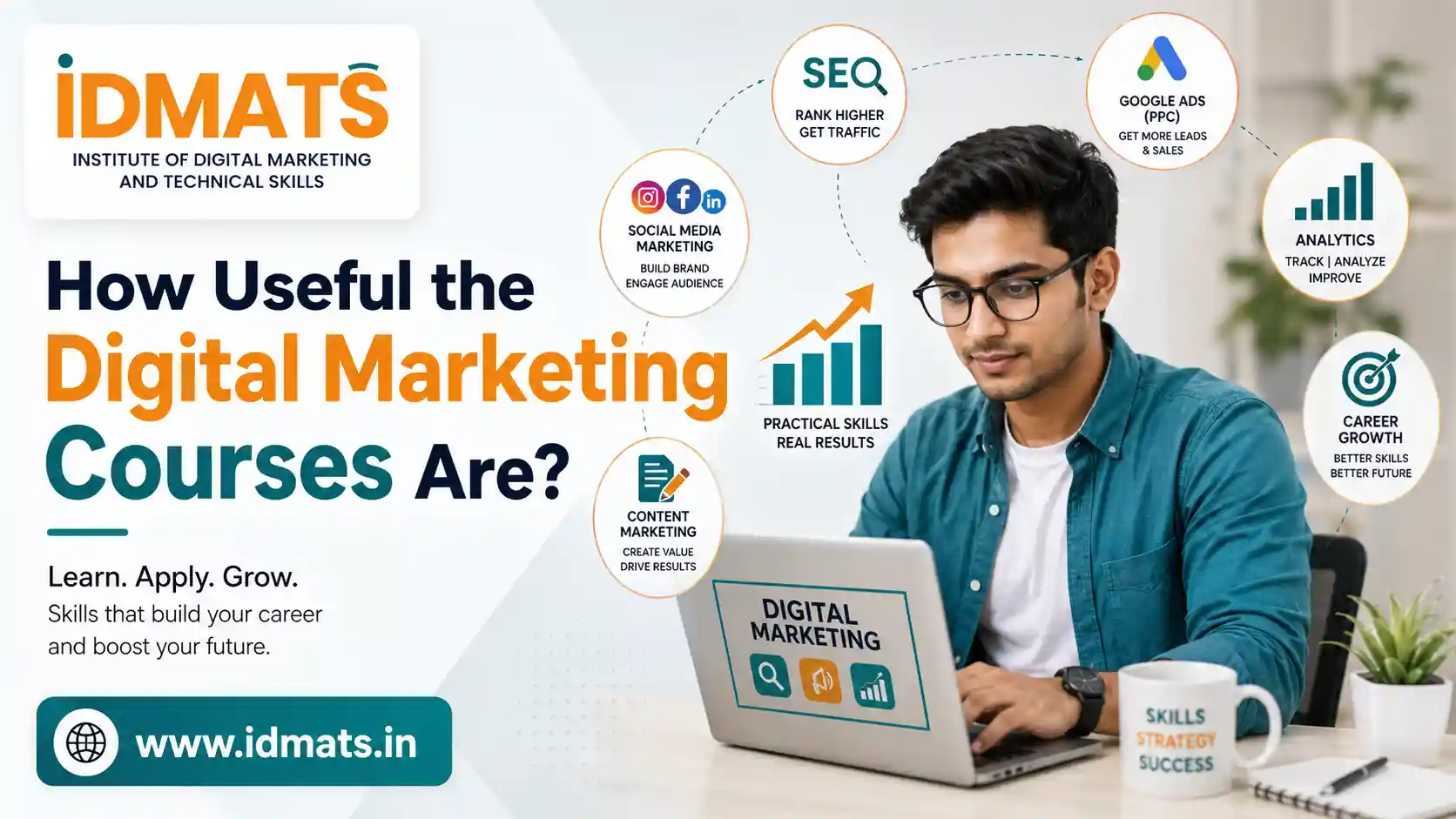
Digital marketing courses can be very useful when they teach practical skills, current tools and real marketing work rather than only theory. They can help students, freshers, working professionals, freelancers and business owners learn skills such as SEO, social media marketing, Google Ads, content marketing, analytics and email marketing.
For learners in Agra, choosing a top digital marketing institute in Agra can make the learning process more structured, especially when the course includes practical assignments, live projects, portfolio work and career guidance. IDMATS focuses on digital and technical skill training designed to help learners understand how digital marketing works in real business situations.
The important point is this: a digital marketing course does not automatically guarantee a job or business success. Its value depends on what you learn, how much you practise and whether you can apply those skills to real projects.
Why Are Digital Marketing Courses Useful?
Digital marketing is a practical field. Businesses use websites, search engines, social media, online advertising, email and content to reach customers.
A structured course can help you learn these areas in the right order instead of trying to understand everything separately through random videos and articles.
A good course can help you:
Understand the basics of digital marketing
Learn SEO and search engine optimisation
Create and manage social media campaigns
Understand Google Ads and paid advertising
Learn content marketing
Work with analytics and performance data
Understand lead generation
Build websites and landing pages
Learn email marketing
Use AI tools responsibly
Create marketing strategies
Build practical projects for your portfolio
The value comes from learning + practice + feedback, not simply from receiving a certificate.
What Does a Digital Marketing Course Actually Teach?
Digital marketing is not one single skill. It is a group of connected skills used to attract, engage and convert an online audience.
A well-designed programme may cover the following areas.
Search Engine Optimisation
SEO helps websites appear in relevant organic search results.
Students normally learn areas such as:
Keyword research
Search intent
On-page SEO
Technical SEO
Internal linking
Content optimisation
Local SEO
Off-page SEO
Search Console
SEO analytics
SEO is useful for businesses that want long-term organic visibility rather than depending completely on paid advertising.
Social Media Marketing
Social media marketing involves planning and publishing content on platforms such as Instagram, Facebook, LinkedIn and YouTube.
Students can learn:
Content planning
Social media strategy
Audience research
Content formats
Engagement
Social media analytics
Paid social campaigns
Brand communication
This skill can be useful for agencies, businesses, creators and freelancers.
Google Ads and Paid Marketing
Paid advertising allows businesses to reach people based on searches, interests, demographics and other targeting signals.
A practical course should explain concepts such as:
Campaign structure
Keyword targeting
Search ads
Display advertising
Conversion tracking
Landing pages
Budget management
Performance measurement
Remarketing
Learning the interface is only one part. Understanding why a campaign succeeds or fails is more important.
Content Marketing
Content is used to answer questions, educate audiences and support business goals.
Digital marketing learners may work with:
Blog posts
Landing pages
Social media content
Videos
Infographics
Email content
Case studies
Guides
Good content should be useful to the audience instead of being written only to insert keywords.
Are Digital Marketing Courses Useful for Getting a Job?
Yes, they can improve your chances of entering the field, but the course itself is not a job guarantee.
Employers usually want more than a certificate. They may look for practical understanding, communication skills, analytical thinking and the ability to use relevant tools.
For example, a beginner applying for an SEO role could strengthen their profile by showing:
A keyword research project
An SEO audit
A sample content plan
A technical SEO checklist
Search Console analysis
A sample reporting dashboard
This gives an employer something concrete to evaluate.
Can Beginners Learn Digital Marketing?
Yes.
You do not necessarily need to be from a computer science or marketing background. Students from different educational backgrounds can learn digital marketing if they are willing to practise.
A beginner normally needs:
Basic computer knowledge
Internet skills
Interest in online marketing
Basic communication ability
Willingness to practise
Patience to analyse results
You do not need to know SEO, Google Ads or analytics before joining a beginner-level course. These are skills that can be learned step by step.
How to Learn Digital Marketing from Scratch?
If you are starting from zero, avoid trying to learn ten tools at the same time.
A simple learning path is:
Step 1: Understand Digital Marketing
First learn how websites, search engines, social media, online advertising and content work together.
Step 2: Learn SEO
Start with keyword research, search intent, on-page optimisation and basic technical SEO.
Step 3: Learn Content Marketing
Practise writing useful articles, website copy, social media posts and landing-page content.
Step 4: Learn Social Media
Understand content calendars, audience targeting, engagement and social media campaigns.
Step 5: Learn Paid Advertising
Move into Google Ads and social media advertising once you understand the basic marketing funnel.
Step 6: Learn Analytics
Understand traffic, conversions, engagement, campaign performance and other important metrics.
Step 7: Work on Projects
This is where your knowledge starts becoming practical.
Build a small website, create a content plan, perform an SEO audit or design a sample advertising campaign.
Step 8: Build a Portfolio
Keep your best projects together so you can show potential employers or clients what you can actually do.
Are Digital Marketing Courses Useful for Freelancing?
They can be.
Freelancing requires more than marketing knowledge. You also need communication, client handling, pricing, reporting and time-management skills.
Digital marketing freelancers can offer services such as:
SEO
Local SEO
Social media management
Google Ads
Content marketing
Email marketing
Website optimisation
Analytics and reporting
A beginner should not try to sell every service immediately.
It is usually better to become good at one or two areas first and gradually expand.
For example, someone who enjoys SEO could start with:
Keyword research → on-page SEO → local SEO → SEO audits → monthly SEO management
This creates a clearer service offering.
Can Business Owners Benefit From a Digital Marketing Course?
Absolutely.
A business owner does not necessarily need to become a full-time digital marketer. Even basic knowledge can help them understand what an agency or freelancer is doing.
For example, a business owner who understands:
Search intent
Google Business Profile
SEO
Google Ads
Social media
Conversion tracking
Website performance
can make better decisions about their online marketing budget.
It also becomes easier to identify unrealistic promises.
Is a Digital Marketing Certificate Enough?
No. A certificate is useful, but it should not be treated as proof of complete expertise.
A certificate can show that you completed a programme. Your practical work demonstrates what you can actually do.
Think of it this way:
Certificate = evidence of learning
Portfolio = evidence of application
Experience = evidence of working in real situations
The strongest beginner profile combines all three.
What Makes a Digital Marketing Course Worth Taking?
Not every course provides the same value.
Before enrolling, check whether the programme includes:
Practical Training
You should get opportunities to apply what you learn.
Real or Simulated Projects
Projects help turn concepts into practical experience.
Industry Tools
The course should introduce tools that marketers actually use.
Analytics
Marketing without measurement is difficult to improve.
Current AI Skills
AI can help with research, content ideation, analysis and repetitive tasks, but learners should also understand fact-checking, originality and human judgement.
Portfolio Development
A portfolio can be more useful than a long list of completed lessons.
Career Guidance
Resume preparation, interview practice and career guidance can be helpful for beginners.
What Career Options Can Digital Marketing Lead To?
Digital marketing has several specialisations.
Depending on your interests and experience, you could work towards roles such as:
SEO Executive
SEO Specialist
Social Media Executive
Social Media Manager
PPC Executive
Google Ads Specialist
Content Writer
Content Marketing Executive
Digital Marketing Executive
Email Marketing Specialist
Performance Marketing Executive
Digital Marketing Analyst
Affiliate Marketing Specialist
E-commerce Marketing Executive
The exact role, salary and career progression depend on skills, experience, location, employer and performance.
Digital Marketing Courses and AI: Are They Still Relevant?
Yes, but the way people learn digital marketing is changing.
AI tools can now help with tasks such as:
Brainstorming
Content outlines
Data analysis
Research assistance
Ad copy ideas
Image creation
Report summaries
Workflow automation
However, AI does not remove the need to understand marketing fundamentals.
A marketer still needs to know:
Who is the customer?
What problem are they trying to solve?
What message should the brand communicate?
Which channel should be used?
What does success look like?
How should campaign results be evaluated?
These decisions require context and judgement.
Google's current Search guidance also emphasises useful, original content and warns against creating large amounts of low-value content simply to manipulate rankings. Its spam policies apply to attempts to manipulate generative AI search features as well.
That makes real knowledge, first-hand experience and useful information increasingly important for digital marketers.
How Digital Marketing Helps Different Types of Learners
For Students
It can provide an additional skill alongside a degree or formal education.
For Freshers
It can open entry-level opportunities in SEO, social media, content, PPC and digital marketing.
For Working Professionals
It can help professionals move towards digital roles or add marketing skills to their existing career.
For Entrepreneurs
It can help business owners understand online customer acquisition.
For Freelancers
It can create opportunities to offer specialised marketing services to clients.
How Long Does It Take to Learn Digital Marketing?
There is no fixed answer.
Basic concepts can be learned within a few months with regular study and practice. Becoming genuinely good at digital marketing takes longer because you need experience with different situations and campaigns.
A realistic progression could be:
Month 1: Fundamentals and marketing concepts
Months 2–3: SEO, content and social media
Months 3–4: Paid advertising and analytics
Months 4+: Projects, portfolio and specialisation
The timeline will differ depending on the course structure and the amount of practice you do outside class.
Common Mistakes Beginners Make
Digital marketing becomes much easier when you avoid a few common mistakes.
Learning Only Theory
Watching lessons without doing projects will limit your progress.
Chasing Every New Tool
You do not need to learn every AI or marketing tool available.
Ignoring Analytics
If you cannot measure results, it becomes difficult to understand whether your marketing is working.
Focusing Only on Certificates
A certificate is useful, but practical ability matters too.
Expecting Instant Results
SEO, content and social media growth can take time. Paid advertising also requires testing and optimisation.
Copying Other People's Work
Study good examples, but learn to create original strategies and content.
How to Choose a Digital Marketing Course
Before joining, ask these questions:
Is the course beginner-friendly?
Does it include practical assignments?
Will I work on projects?
Which tools are included?
Does it teach analytics?
Does it cover SEO and paid advertising?
Is AI included in a practical way?
Will I build a portfolio?
Is there career or interview support?
Can I speak with previous students?
Do not choose a course only because its advertisement says “best”, “guaranteed job” or “100% placement”. Look at the actual curriculum, training method and evidence of practical learning.
Google's current guidance also encourages accurate, useful information and warns against manipulative practices designed primarily to influence rankings or AI-generated search responses.
Is Digital Marketing a Good Career Choice?
For many people, yes.
Digital marketing offers multiple specialisations, and its skills can be used by companies, agencies, startups, e-commerce businesses, creators and freelancers.
But it is not a shortcut to easy money.
You need to learn continuously, practise regularly and understand how digital channels affect business results.
Someone who learns only how to operate a tool may struggle when the tool changes. Someone who understands audience behaviour, search intent, content, data, conversion and strategy can adapt more easily.
Frequently Asked Questions
Are digital marketing courses really useful?
Yes. A good course can provide a structured way to learn SEO, social media, paid advertising, content marketing, analytics and other digital skills. The value increases when the programme includes practical projects and portfolio work.
Is digital marketing suitable for beginners?
Yes. Beginners can start without an advanced technical background. Basic computer knowledge, curiosity and regular practice are enough to begin.
Can I get a job after completing a digital marketing course?
A course can improve your skills and prepare you for entry-level opportunities, but employment is not automatic. Employers also consider practical ability, communication, experience, portfolio quality and interview performance.
Is a digital marketing certificate worth it?
It can be useful as evidence that you completed structured training. However, a certificate should be supported by practical projects and demonstrable skills.
Can I learn digital marketing without joining an institute?
Yes. There are many online resources available. An institute can still be useful if you prefer structured learning, trainer guidance, classroom interaction, practical assignments and a fixed learning path.
Is digital marketing still useful with AI?
Yes. AI is changing how marketers work, but it does not remove the need for marketing strategy, customer understanding, analytics, creativity and decision-making. In many cases, AI becomes another tool that skilled marketers use.
Final Answer: How Useful Are Digital Marketing Courses?
Digital marketing courses are useful when they help you develop skills that you can actually apply. They can provide a structured learning path across SEO, social media, Google Ads, content marketing, analytics, email marketing, AI tools and other areas.
The most useful course is not necessarily the one with the biggest number of modules. Look for practical training, real projects, current tools, experienced guidance, portfolio development and career support.
Most importantly, remember that a course is only the starting point. Your results will depend on how seriously you practise, how well you understand marketing and how effectively you apply your skills to real problems.
For someone starting today, the best approach is simple: learn the fundamentals, practise on projects, measure your results, build a portfolio and keep improving.
Google's current documentation confirms that SEO fundamentals remain relevant for its generative AI search features, while structured data can help Google understand page content when implemented correctly.
That is why learning digital marketing is not simply about learning today's tools. It is about learning how digital marketing works so you can continue adapting as the tools change.