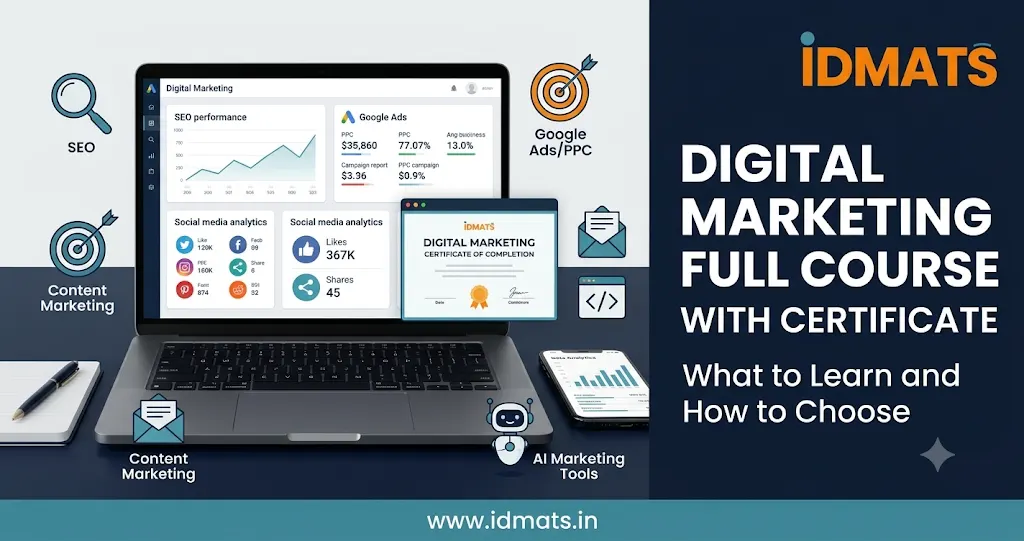
Picking a training program is a big decision. A digital marketing full course with certificate can change your career. The wrong one wastes months and money. This guide explains what a strong program covers, how employers view certificates, and how to compare your options. It draws on hands-on training experience at IDMATS. By the end, you will know exactly what to check before you enrol.
Student following a digital marketing full course with certificate on a laptop
What Is a Digital Marketing Full Course with Certificate?
A digital marketing full course with certificate is a structured program that teaches every major online marketing channel. It ends with a credential you can show to employers and clients. Most programs combine video lessons, live sessions, tools practice, and a final project.
Full Course vs. Single-Skill Training
A single-skill class teaches one topic, such as SEO training or Google Ads training. A full course teaches the whole system. As a result, you learn how channels support each other. For example, content feeds search, search feeds email, and email feeds sales.
What the Certificate Actually Proves
A certificate proves that you finished the training. It does not prove that you can deliver results. However, a good program pairs the certificate with graded projects. Those projects become your portfolio. Employers trust the portfolio more than the paper.
Who Should Take a Digital Marketing Course Online?
An online digital marketing course suits many learners. A digital marketing full course with certificate suits those who want proof of skill. Flexible schedules make it practical for people with jobs or classes. Moreover, you can learn from any country, because the tools and platforms are global.
Beginners and Career Changers
Beginners need a clear path from basics to practice, and a digital marketing full course with certificate gives that path. Career changers need speed and proof of skill. Both groups benefit from a full course because it removes guesswork. You follow one roadmap to learn digital marketing instead of piecing together random videos.
Business Owners and Working Professionals
Owners can stop paying agencies for basic tasks. Professionals can add search, social, or analytics skills to their current role. In both cases, the goal is the same. You want to learn digital marketing in a way that produces measurable results.
What a Complete Digital Marketing Course Syllabus Should Cover
Syllabi vary widely between providers. Therefore, compare the digital marketing course syllabus line by line. A complete digital marketing full course with certificate should include the modules below.
Search Engine Optimization (SEO)
SEO brings free, lasting traffic. Your training should cover keyword research, on-page work, technical audits, and link building. It should also teach how to write for AI-driven search. Google explains its quality expectations in its helpful content guidance.
Content and Social Media Marketing
Content marketing builds trust. Social media marketing builds reach and community. Good lessons show you how to plan a calendar, write for each platform, and measure engagement. Practice matters in social media marketing. You should publish real posts, not just watch demos.
Paid Advertising
Paid ads deliver fast traffic. Your course should include Google Ads training and paid social campaigns. You should learn budgets, bidding, audience targeting, and ad copy. In addition, look for lessons on conversion tracking. Without tracking, you cannot prove that ads work.
Email Marketing and Automation
Email still drives strong returns for many businesses. A solid module covers list building, segmentation, and automation flows. It also covers deliverability. Otherwise, your messages may never reach the inbox.
Analytics and Reporting
Data turns opinions into decisions. You should learn Google Analytics, a core part of any digital marketing course syllabus, dashboards, and simple reporting. Furthermore, you should practice explaining numbers to non-experts. That skill gets people promoted.
AI Tools and Generative Engine Optimization
Search is changing, and SEO training must change with it. People now ask questions in AI Overviews, ChatGPT, and Perplexity. Marketers must learn how to earn citations in those answers. A modern course teaches clear structure, expert sourcing, and direct answers. It also teaches responsible use of AI writing tools.
Do Employers Value a Digital Marketing Certification?
Yes, but with limits. A digital marketing certification helps you pass the first screening. It shows initiative and a basic knowledge level. However, hiring managers still ask for proof of skill.
What Hiring Managers Look For
Managers look for three things. First, they want a portfolio with real campaigns. Second, they want comfort with tools. Third, they want clear thinking about results. A certificate supports these points but cannot replace them.
Platform Credentials Add Weight
Platform-issued credentials add extra trust. Google offers free learning and certifications through Google Skillshop. Pairing one of these with your digital marketing full course with certificate strengthens your profile. As a result, you stand out from candidates who list only one credential.
How to Choose the Best Digital Marketing Full Course with Certificate
Many providers make big promises, so be careful. Use the checklist below to compare them fairly. A genuine digital marketing full course with certificate should pass every point.
Curriculum and Trainer Quality
First, check who teaches the lessons. Trainers should have real campaign experience. Ask for their names and backgrounds. Then compare the syllabus to the module list above. If major topics are missing, move on.
Practical Projects and Tools Access
Theory alone does not build skill. Look for live projects, tool practice, and feedback on your work. Ask whether you will run a real campaign. Also ask which tools you will use. Real tools teach real habits.
Certificate Recognition and Transparency
Ask who issues the certificate. Find out whether it carries any industry recognition. Be careful with providers that guarantee jobs. Instead, honest institutes explain placement support clearly and avoid empty promises.
Support, Community, and Updates
Marketing changes every month. Therefore, choose a course that updates its lessons often. Ask about doubt-clearing sessions, community access, and career guidance. Good support often decides whether you finish the course.
Career Paths After Your Course
A full course opens several doors. You can join an agency, work in-house, freelance, or start your own business. Each path rewards different strengths.
Common Digital Marketing Roles
A digital marketing career often starts in a few common roles. These include SEO executive, social media manager, content marketer, paid media specialist, and email marketer. With experience, you can grow into strategist, manager, or head of growth. Analytics skills speed up that climb.
Market Outlook
Demand for marketing and research skills looks healthy. The U.S. Bureau of Labor Statistics projects faster-than-average growth for market research analysts. Salaries differ by country, role, and experience. Check local job boards for current ranges before you set expectations.
How Long Does It Take to Learn Digital Marketing?
Most programs that offer a digital marketing full course with certificate run from three to six months. Pace depends on your schedule and prior experience. Part-time learners may need longer. Fast-track learners can finish sooner, but they must practice daily.
A Simple Study Plan
Try this rhythm. Spend the first month on SEO and content basics. For example, write and publish two articles. Spend the second on social media and email. Use the third for paid ads and analytics. Finally, build a capstone project that combines every channel.
Practice Beats Passive Watching
Watching videos feels productive, yet it rarely builds skill. Build a small blog or a test store instead. Run a small ad budget. Review the data weekly. This habit teaches more than any lecture.
Tools You Will Use in a Digital Marketing Full Course with Certificate
Tools turn knowledge into results, so they matter. A practical program gives you hands-on access to the platforms professionals use daily. Therefore, check the tool list before you enrol.
Core Tools for Search and Analytics
You should practice with Google Search Console, Google Analytics, and a keyword research platform. In addition, learn a site audit tool. These tools show you what works. For example, Search Console reveals which queries bring visitors to a page.
Tools for Social, Email, and Ads
Expect to use a scheduling tool for social posts. You will also need an email platform and the Google Ads interface. Meta Ads Manager is equally important. As a result, you can run a small test campaign from start to finish.
Design and AI Assistants
Basic design skills help every marketer. A simple design tool covers social graphics and banners. Meanwhile, AI assistants speed up research and drafting. However, you must edit their output. Readers and search engines both reward original, accurate work.
Digital Marketing Course Fees and Real Value
Fees depend on format, depth, and support. Instead of comparing price alone, compare value. A cheaper program with no feedback may cost you more in lost time.
What You Are Really Paying For
In most cases, good fees cover expert trainers, live practice, project reviews, and updated lessons. Some programs also include career support. Ask each provider what is included. Then request that list in writing.
Questions to Ask Before You Pay
Ask whether sessions are live or recorded. Then check how many projects you will complete. Find out how often the syllabus changes. Finally, see whether past students will share their experience. Honest providers answer these questions without pressure.
What Experience Tells Us About Successful Learners
Across training batches, a clear pattern appears. Learners who publish work during the course progress faster than those who only watch lessons. Their portfolios give interviewers something concrete to review.
Habits That Help You Finish
First, set a fixed weekly schedule. Next, join a study group. Share your projects for feedback every week. Consistency matters more than long, rare study sessions. Moreover, small wins keep motivation high.
How to Show Your Skills After Graduation
Create a simple portfolio site. Then add three to five case studies. For each one, explain the goal, the steps, and the result. Then link your certificate and platform credentials. Employers and freelance clients can verify your skills quickly.
Common Mistakes to Avoid
Learners often repeat the same errors. Avoid these and you will progress faster.
Chasing Certificates Without Skills
Collecting many certificates looks impressive but proves little. Instead, finish one strong program and build proof of work. In short, quality beats quantity.
Ignoring Fundamentals
Some students jump straight to advanced tricks. However, strong basics in audience research, messaging, and measurement matter more. Tools change, but fundamentals last.
Why a Full Course Beats Random Free Videos
Free videos are a good start, and many learners begin there. However, scattered videos rarely build a complete skill set. You may learn a trick but miss the strategy behind it.
Structure Saves Time
A digital marketing full course with certificate gives you a clear order. You learn the basics first. Then you move to tools, and then to strategy. As a result, you waste less time and avoid gaps.
Feedback Speeds Up Growth
Feedback is the biggest advantage of a guided program. A trainer can spot errors in your ad copy or site structure. As a result, you fix them early. Without that help, small mistakes can stay for months.
Accountability Keeps You Moving
Deadlines and live classes keep you on track. Therefore, you are more likely to finish. Many people start self-paced learning and stop in week two. A good program prevents that.
Final Checklist Before You Enrol
Use this short list as your last step before any online digital marketing course. First, confirm that the syllabus covers SEO, social media, paid ads, email, and analytics. Second, confirm that you will complete real projects. Third, confirm who issues the certificate. Fourth, confirm that trainers are active marketers. If every answer is yes, the digital marketing full course with certificate you are considering is likely a safe choice.
Frequently Asked Questions
Is a digital marketing full course with certificate worth it?
Yes, a digital marketing full course with certificate is worth it if it includes practical projects and updated lessons. The certificate opens doors, and the portfolio closes the deal. Always compare syllabus, trainers, and support before you pay.
How much does a digital marketing course cost?
Prices vary by country, format, and depth. Free courses teach basics. Paid programs usually add live training, feedback, and projects. Ask each provider for a full fee breakdown.
Can I learn digital marketing without a degree?
Yes. In fact, most employers care more about skills and results than about degrees. A strong portfolio and a trusted certificate are often enough to start.
Which certificate is best for digital marketing?
No single certificate wins everywhere. Combine a full-course certificate with platform credentials, such as Google's. This mix shows both broad and tool-specific skill.
Start Your Digital Marketing Journey with IDMATS
A digital marketing full course with certificate should teach you every core channel and prove your skill through real projects. Use the checklist in this guide to compare programs honestly. Then pick the one that matches your goals and schedule.
Ready to take the next step? Then explore a digital marketing full course with certificate built for real results. Explore the IDMATS digital marketing course and review the full syllabus. You can also read our guide to SEO training for beginners or compare social media marketing lessons. Start small, practice often, and keep learning.