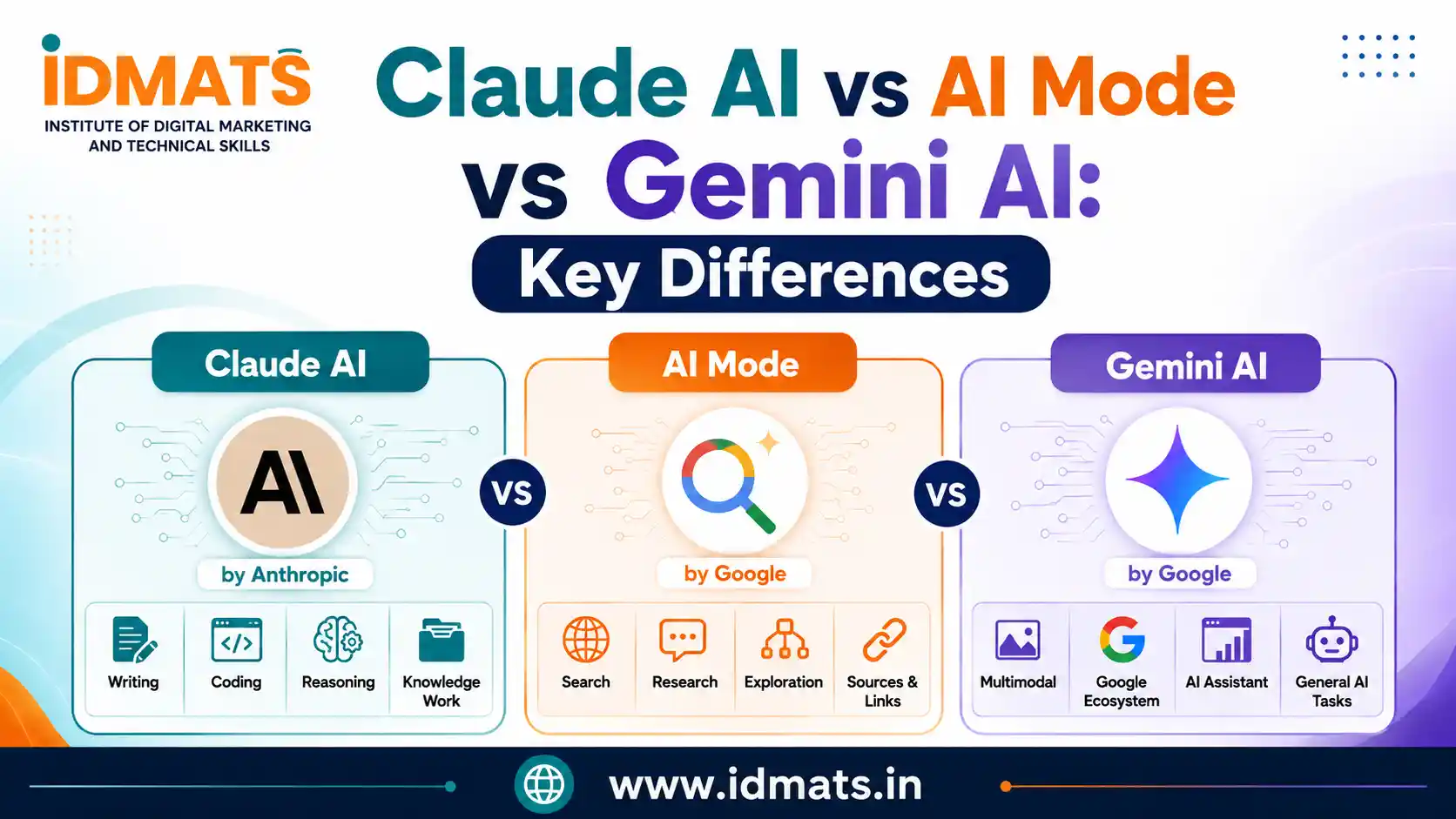
If you are comparing Claude AI, Google AI Mode, and Gemini AI, the first thing to understand is that these are not three identical products.
Claude AI is Anthropic’s AI assistant and model family. Gemini AI is Google’s family of AI models and assistant experiences. AI Mode is a Google Search experience that uses Gemini technology to answer complex questions, search across multiple web sources, and support follow-up conversations.
So, which one should you use?
Use Claude when your priority is writing, coding, detailed reasoning, documents, and agent-style work. Use Gemini when you want a broad multimodal AI connected closely with Google’s ecosystem. Use Google AI Mode when your main goal is researching the web, comparing information, and exploring questions through Google Search.
That is the short answer. Now let’s look at the differences in detail.
Claude AI vs AI Mode vs Gemini AI at a Glance
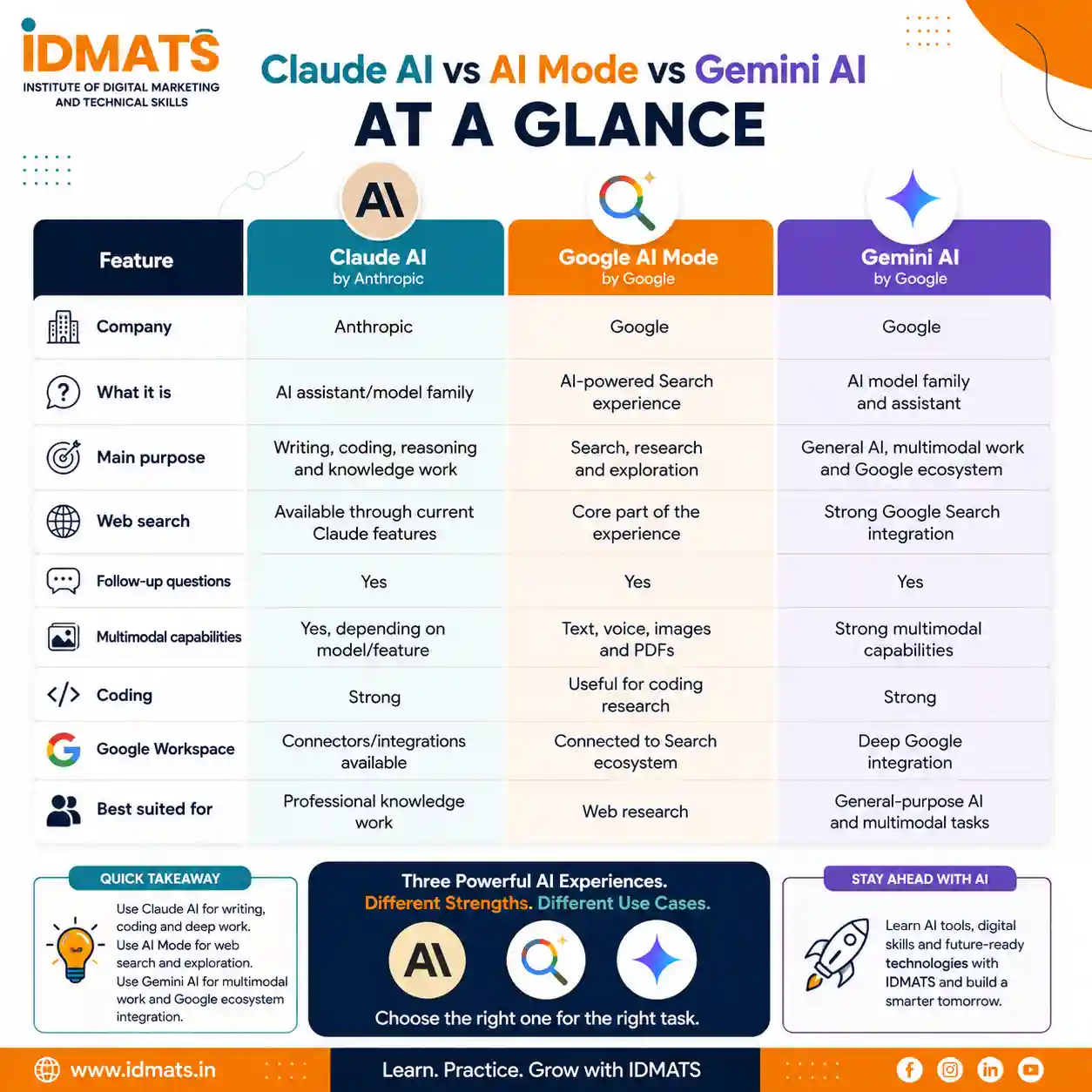
Feature | Claude AI | Google AI Mode | Gemini AI |
|---|---|---|---|
Company | Anthropic | ||
What it is | AI assistant/model family | AI-powered Search experience | AI model family and assistant |
Main purpose | Writing, coding, reasoning and knowledge work | Search, research and exploration | General AI, multimodal work and Google ecosystem |
Web search | Available through current Claude features | Core part of the experience | Strong Google Search integration |
Follow-up questions | Yes | Yes | Yes |
Multimodal capabilities | Yes, depending on model/feature | Text, voice, images and PDFs | Strong multimodal capabilities |
Coding | Strong | Useful for coding research | Strong |
Google Workspace | Connectors/integrations available | Connected to Search ecosystem | Deep Google integration |
Best suited for | Professional knowledge work | Web research | General-purpose AI and multimodal tasks |
The exact capabilities can vary by model, plan, region and product version, so it is better to compare the workflow rather than assume that one tool is always better.
What Is Claude AI?
Anthropic develops Claude, an AI assistant and family of AI models designed for tasks such as writing, coding, reasoning, analysis and professional work.
Anthropic has continued expanding Claude's model family in 2026. Its current product announcements include Claude Opus 5 and Claude Sonnet 5, with Opus 5 positioned for demanding knowledge work and long-running agentic tasks, while Sonnet 5 focuses strongly on coding, tool use, agents and professional work.
Claude is particularly interesting for people who want an AI assistant that can work through detailed instructions instead of simply producing a quick answer.
What Can Claude AI Do?
Depending on the model and available features, Claude can help with:
Writing and editing
Coding and debugging
Document analysis
Research
Data and knowledge work
Brainstorming
Complex reasoning
Creating structured content
Agentic workflows
Working with connected tools
Anthropic has also developed Claude Code, which focuses on software development workflows, and Claude's broader tool ecosystem supports more advanced ways of working with AI.
What Is Gemini AI?
Google develops Gemini through its AI and Google DeepMind ecosystem.
Unlike a single chatbot, Gemini refers to a family of AI models and a wider set of Google AI experiences. Gemini is designed for text, images and other forms of information, making multimodal work one of its important strengths.
Google has also integrated Gemini technology into products such as Google Search and AI Mode. Google introduced Gemini 3 into Search and AI Mode to provide stronger reasoning and more interactive search experiences.
What Can Gemini AI Do?
Gemini can be used for tasks such as:
Writing
Research
Coding
Image understanding
Document analysis
Brainstorming
Summarisation
Data-related tasks
Google Workspace workflows
Multimodal questions
Its connection with Google's broader ecosystem is one of its biggest advantages.
If your daily work already involves Google Search, Gmail, Docs, Drive, Sheets, YouTube or Android, Gemini can fit naturally into that workflow.
What Is Google AI Mode?
This is where many comparisons become confusing.
AI Mode is not simply another chatbot competing with Claude and Gemini. It is a mode inside Google Search.
Google describes AI Mode as its most powerful AI search experience. It can take a question, break it into different subtopics, search for information across multiple sources and bring the results together into a conversational response. This process is known as query fan-out.
In simple words:
Traditional Google Search:
You search → Google shows results → You visit websites.
AI Mode:
You ask a complex question → AI Mode researches multiple aspects → It creates a response → You can ask follow-up questions → It provides links to explore further.
That makes AI Mode especially useful for research-heavy searches.
Is AI Mode the Same as Gemini?
No, but they are closely connected.
Gemini is Google's AI model family. AI Mode is a Google Search experience that uses Gemini models and Google's search infrastructure.
Google has explained that Gemini models power AI features in Search, including AI Mode. Its current Search documentation also states that Gemini 3 Pro can be used in AI Mode for more advanced reasoning, while a faster model is available for general assistance.
Think of it like this:
Gemini = the AI intelligence
AI Mode = the AI-powered Search experience
This distinction is important when comparing Claude AI vs AI Mode vs Gemini AI.
Claude AI vs Gemini AI: Which Is Better?
There is no single winner for every task.
Claude and Gemini are increasingly capable across many of the same areas, so the better choice depends on your workflow.
Claude May Be Better for Writing
Claude has developed a strong reputation for professional writing, editing and instruction-following.
It can be useful when you need:
Long-form articles
Detailed editing
Tone matching
Business writing
Complex instructions
Content restructuring
Document-based work
Recent comparisons also tend to find Claude particularly strong for writing and coding, although results vary depending on the task and model version.
Gemini May Be Better for Google-Centred Work
Gemini becomes particularly attractive if your workflow already depends heavily on Google's ecosystem.
For example, you may want AI assistance while working with:
Google Docs
Gmail
Google Drive
Google Search
YouTube
Android
Google Cloud
This ecosystem advantage can matter more than small differences in model performance.
Gemini Has a Strong Multimodal Focus
Gemini is designed to work across different types of information, including text, images, audio and video depending on the product and model.
This makes it useful when your task is not simply “read this text and answer me”.
For example, you may want to analyse a document, understand an image, work with visual information or combine several types of input.
AI Mode vs Gemini: What Is the Difference?
This is probably the most important comparison in this topic.
Gemini
Gemini is Google's broader AI model and assistant ecosystem.
You can use it for general AI tasks such as writing, brainstorming, coding, analysis and multimodal work.
AI Mode
AI Mode is built specifically around search and exploration.
It is designed for questions where you want information from the web and may need several searches to reach a useful answer.
Google says AI Mode can split a complex query into subtopics and search them simultaneously before combining the information into a response.
Simple Example
Suppose you ask:
“Compare the best digital marketing courses in Agra based on syllabus, fees, practical training and career support.”
With a normal AI assistant, you may need to provide sources or ask it to research.
With Google AI Mode, the experience is designed around searching the web, comparing information and allowing you to continue asking questions.
That is why AI Mode is closer to an AI-powered search experience than a standalone chatbot.
Claude AI vs AI Mode: Which One Should You Use?
The answer depends on what you are doing.
Choose Claude for:
Writing and editing
Coding
Long documents
Complex instructions
Professional knowledge work
Agentic workflows
Detailed analysis
Choose AI Mode for:
Current web research
Comparing products or services
Exploring unfamiliar topics
Finding multiple sources
Follow-up research
Questions involving current web information
Google itself recommends checking important information across multiple sources because AI Mode can still misunderstand content or miss context.
That is an important point: AI search is not automatically the same as verified information.
Which Is Better for SEO and Content Research?
For SEO professionals, the answer is more interesting because all three can be useful in different stages.
Claude AI for Content Development
Claude can help with:
Content outlines
Topic clusters
Article structure
Editing
Search-intent analysis
Content briefs
Rewriting
FAQ development
Gemini for Research and Google Ecosystem
Gemini can help with research, multimodal information and workflows connected to Google's ecosystem.
AI Mode for Search Behaviour
AI Mode is particularly interesting for SEO because it reflects Google's shift towards conversational search.
Google says AI Mode is designed to help users explore topics through deeper questions, follow-ups and web links. Google has also reported that AI Mode had surpassed one billion monthly users globally by May 2026.
For publishers and SEO professionals, this means understanding how users ask questions is becoming increasingly important.
What Does This Mean for SEO in 2026?
SEO is no longer only about ranking a page for one exact keyword.
Search engines are becoming better at understanding:
Search intent
Context
Related entities
User questions
Topical relationships
Supporting information
First-hand experience
Trust signals
Google has also introduced new tools and guidance for website owners as AI features become a larger part of Search.
This means websites should focus on creating useful content that genuinely answers questions instead of writing pages simply to repeat keywords.
The Role of Entities in Claude, Gemini and AI Search
Entity understanding is becoming increasingly important.
For example, the topic “Claude AI vs AI Mode vs Gemini AI” is not only about three keywords.
The related entities include:
Anthropic
Claude
Claude Opus
Claude Sonnet
Claude Code
Google
Google DeepMind
Gemini
Gemini models
Google Search
AI Mode
AI Overviews
Google Workspace
Deep Research
Search Console
Generative AI
Multimodal AI
AI agents
Large language models
A well-structured article connects these entities naturally instead of repeatedly forcing the same keyword into every paragraph.
AI Mode vs AI Overviews
Another common confusion is AI Mode vs AI Overviews.
They are related, but they are not exactly the same.
AI Overviews provide an AI-generated snapshot within Google Search when Google's systems determine that generative AI can be useful. They can include key information and links to supporting pages.
AI Mode provides a deeper conversational search experience where users can ask complex questions, explore different subtopics and continue with follow-up questions.
A simple way to remember it:
AI Overviews = AI summary within Search
AI Mode = deeper conversational AI Search
Which AI Is Best for Students?
Students can benefit from all three.
Claude
Useful for:
Explaining difficult concepts
Improving writing
Analysing documents
Coding practice
Brainstorming
Gemini
Useful for:
Research
Multimodal learning
Google ecosystem tasks
Summarising information
Working with different types of content
AI Mode
Useful for:
Finding current information
Comparing sources
Exploring a new topic
Asking follow-up research questions
The best option is therefore not necessarily the AI with the highest benchmark score. It is the one that fits the student's actual work.
Which AI Is Best for Developers?
Developers may find Claude particularly attractive because Anthropic has invested heavily in coding and agentic workflows, including Claude Code and newer agent-oriented models. Anthropic describes Sonnet 5 as a model built for planning, tool use, browsers, terminals, coding and autonomous work.
Gemini is also a strong option, particularly for developers working within Google's technology ecosystem.
AI Mode is less of a direct coding assistant. Its strength is researching technical information through Google Search rather than replacing a dedicated development workflow.
What About AI Agents?
AI agents are an important part of the 2026 AI landscape.
Instead of simply answering a question, an agent can potentially:
Understand a goal.
Create a plan.
Use tools.
Perform multiple steps.
Check results.
Continue working towards the goal.
Anthropic's latest Claude releases have placed considerable emphasis on agentic capabilities, including long-running tasks, coding and tool use.
Google is also developing agentic capabilities across its AI ecosystem.
This is one reason why comparing AI tools only by “which chatbot writes better?” is becoming less useful.
You May Read Also: 15 Skills Actually Matter When AI is Doing Half the Work in 2026
Does Claude Have an Advantage Over Gemini?
In some workflows, yes.
Claude can be a strong choice when the main requirement is careful writing, coding, reasoning or agentic work.
Anthropic's 2026 model releases show a clear focus on professional work, coding and agents.
But this does not mean Claude is universally better.
If you depend heavily on Google's ecosystem or need multimodal and Search-connected workflows, Gemini can be the more practical choice.
Does Gemini Have an Advantage Over Claude?
Yes, particularly when Google's ecosystem is central to your work.
Gemini is deeply connected with Google's broader AI and Search strategy. Google has also integrated Gemini models directly into Search experiences such as AI Mode.
So the question is not simply:
“Is Gemini smarter than Claude?”
A better question is:
“Which AI fits the way I work?”
The Biggest Difference in One Sentence
Here is the easiest way to remember the comparison:
Claude AI is primarily a powerful AI assistant for knowledge work; Gemini AI is Google's broad multimodal AI ecosystem; and AI Mode is Google's conversational AI-powered Search experience built to research and explore information from the web.
Final Verdict: Claude AI vs AI Mode vs Gemini AI
There is no universal winner.
Choose Claude AI if your priority is writing, coding, detailed reasoning, document work and agentic workflows.
Choose Gemini AI if you want a broad multimodal assistant that fits naturally into Google's ecosystem.
Choose Google AI Mode if your primary goal is web research, complex searches, source discovery and conversational exploration.
And there is no reason you must use only one.
A practical 2026 workflow could look like this:
AI Mode → research current information
Gemini → explore multimodal or Google-connected tasks
Claude → analyse, write, code or refine the final output
The strongest AI users are increasingly becoming tool selectors, not tool loyalists. They choose the system that fits the task and verify important information before acting on it.
People Also Ask
Is Claude AI better than Gemini?
Neither is universally better. Claude can be particularly strong for writing, coding and complex professional work, while Gemini has major advantages in multimodal workflows and Google's ecosystem.
Is AI Mode the same as Gemini?
No. Gemini is Google's AI model family and ecosystem, while AI Mode is an AI-powered Google Search experience that uses Gemini technology and Search infrastructure.
Can AI Mode replace Google Search?
AI Mode changes how Google Search can be used, especially for complex questions, but it still relies heavily on web information and provides links for further exploration.
Which is best for SEO research: Claude, Gemini or AI Mode?
AI Mode is particularly useful for discovering current search information and sources. Claude can be useful for analysing and organising research, while Gemini can support research and Google-connected workflows.
Which AI is best for students in 2026?
It depends on the task. Students can use Claude for writing and reasoning, Gemini for multimodal and Google-based work, and AI Mode for web research and exploring current information.