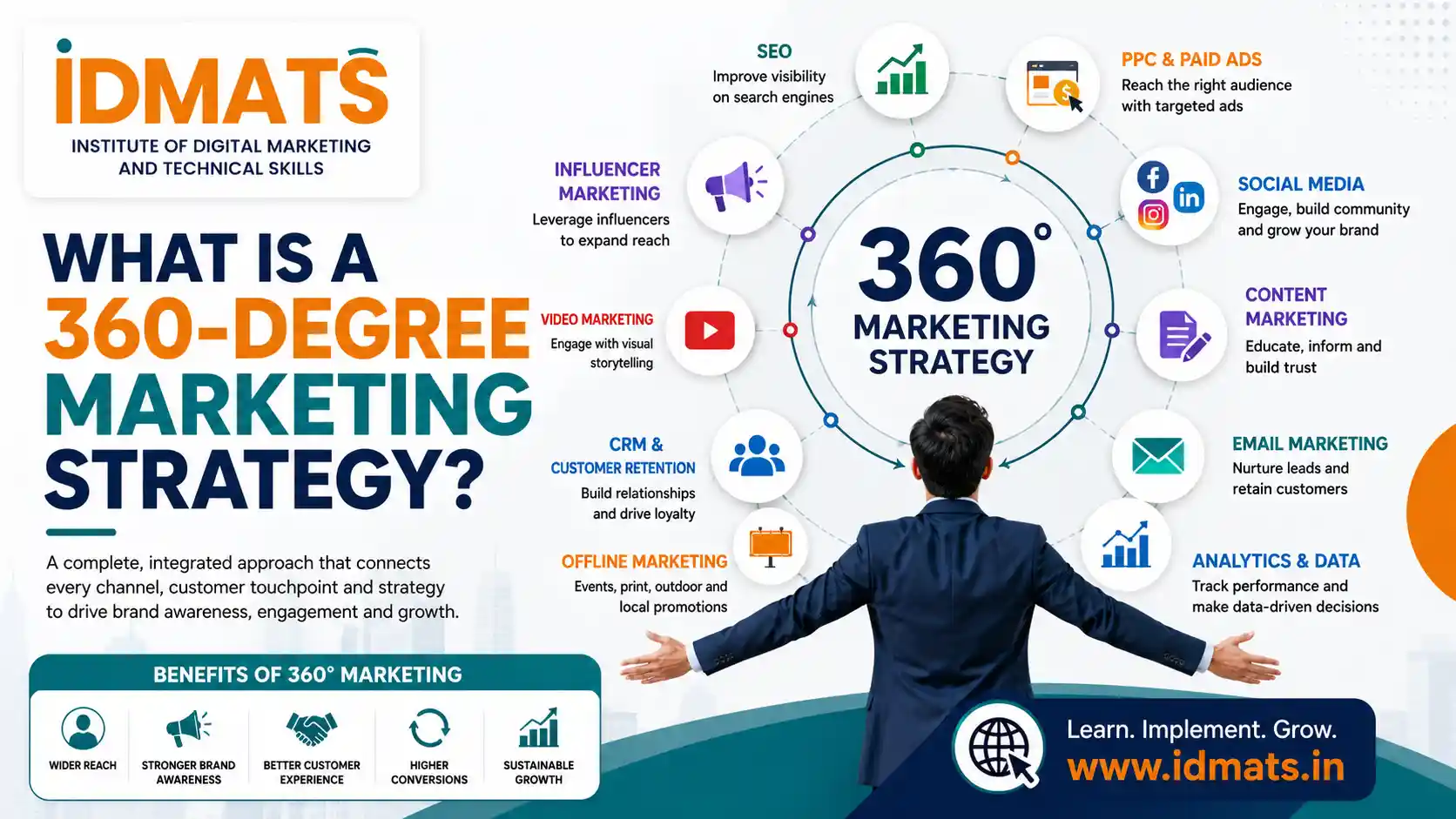
A 360 degree marketing strategy is a complete marketing approach that connects different channels and customer touchpoints into one clear plan. Instead of depending only on SEO, social media, paid ads, email, or offline promotion, a business uses multiple channels together to reach customers at different stages of their buying journey.
For businesses and students learning marketing, Offline digital marketing classes in Agra can also help build a practical understanding of how online and offline activities work together. IDMATS focuses on practical digital marketing concepts that help learners understand how campaigns are planned, executed, measured, and improved.
In simple words, a 360 degree marketing strategy means being present where your customers are, giving them a consistent message, and guiding them from awareness to purchase and beyond.
What Does 360 Degree Marketing Mean?
The term "360 degree" represents a complete view of the customer.
A traditional marketing campaign may focus on one activity, such as running Google Ads. A 360 degree strategy looks at the entire customer journey.
For example:
Customer sees a social media post → visits the website → searches Google → reads a blog → sees a remarketing ad → contacts the business → makes a purchase → receives an email → becomes a repeat customer.
Every stage is connected.
A good 360 degree marketing plan may include:
Search Engine Optimisation (SEO)
Google Ads and PPC
Social media marketing
Content marketing
Email marketing
Influencer marketing
Online reputation management
WhatsApp or messaging campaigns
CRM and customer retention
Analytics and conversion tracking
Offline marketing activities
The exact mix depends on the business, audience, budget, and goals.
You May Like Also: Digital Marketing Side Hustles for Beginners
Why Is a 360 Degree Marketing Strategy Important?
Customers do not use only one platform when deciding what to buy.
A person may discover a brand on Instagram, search for it on Google, watch a YouTube review, visit its website, check customer reviews, and finally contact the company through WhatsApp.
If these channels work separately, the customer experience can become confusing.
A 360 degree strategy helps connect these touchpoints.
1. Customers See Your Brand Across Multiple Channels
Your potential customers may use search engines, social networks, websites, email, YouTube, marketplaces, and offline channels.
A connected strategy increases the chances of reaching them at the right time.
2. Brand Messaging Becomes Consistent
The same business should not appear completely different on its website, social media pages, advertisements, and offline materials.
Your:
Brand message
Visual identity
Offers
Value proposition
Tone of communication
should remain reasonably consistent across channels.
Consistency makes a brand easier to recognise and remember.
3. It Covers the Complete Customer Journey
A 360 degree strategy does not focus only on getting a sale.
It considers different stages:
Awareness → Interest → Consideration → Conversion → Retention → Advocacy
Each stage requires a different type of communication.
For example, educational content may work well during awareness, while testimonials, case studies, offers, or product demonstrations can support the consideration and conversion stages.
What Are the Main Parts of a 360 Degree Marketing Strategy?
There is no single formula that works for every business. However, several important marketing channels usually form the foundation.
Search Engine Optimisation
SEO helps a business appear in organic search results when people search for relevant information, products, or services.
An SEO strategy may include:
Keyword research
Search intent analysis
Technical SEO
On-page optimisation
Content creation
Internal linking
Local SEO
Digital PR and link building
Performance monitoring
For a local business, Google Business Profile optimisation can also be an important part of the strategy.
Search Engine Marketing and PPC
Paid search allows businesses to target people who are actively searching for specific products or services.
Google Ads can be used for:
Search campaigns
Display campaigns
Video advertising
Shopping campaigns
Remarketing
The objective is not simply to generate clicks. A strong PPC campaign should focus on useful traffic, relevant landing pages, conversions, and return on advertising spend.
Social Media Marketing
Social media helps brands communicate directly with their audience.
Platforms can be selected according to the target audience and business objectives.
A social media plan may include:
Educational posts
Short-form videos
Product demonstrations
Customer stories
Polls and discussions
Promotional campaigns
Community engagement
Paid social advertising
The important point is to avoid posting on every platform without a clear purpose.
Content Marketing
Content gives customers useful information before they make a buying decision.
Content can include:
Blog posts
Guides
Case studies
Videos
Infographics
Social posts
E-books
Webinars
FAQs
Product comparisons
Good content should answer real customer questions instead of being created only to insert keywords.
Email Marketing
Email remains useful for nurturing leads and retaining existing customers.
A business can use email for:
Welcome messages
Product updates
Educational newsletters
Offers
Abandoned-cart reminders
Event invitations
Customer retention campaigns
Email becomes more effective when messages are relevant to the recipient instead of sending the same message to everyone.
Website and Landing Pages
Your website is often one of the most important touchpoints in a 360 degree strategy.
Imagine spending money on advertising and social media but sending visitors to a slow or confusing website. The campaign may generate traffic without generating enough business.
A strong website should provide:
Clear information
Easy navigation
Mobile-friendly design
Fast loading
Strong calls to action
Trust signals
Useful product or service details
Simple enquiry or purchase process
Landing pages should be designed around the specific campaign or audience.
Video Marketing
Video can help explain products, services, processes, and ideas quickly.
Businesses can use:
YouTube videos
Short-form videos
Product demonstrations
Tutorials
Customer testimonials
Educational videos
Live sessions
Video can also support SEO and social media campaigns when it is created around genuine audience needs.
Influencer and Creator Marketing
Influencer marketing can help businesses reach established communities.
However, follower count should not be the only selection factor.
A suitable creator should ideally have:
Relevant audience
Good engagement
Credibility
Suitable content style
Audience-location fit
Reasonable campaign costs
For local businesses, a smaller creator with a highly relevant local audience may sometimes be more useful than a large creator with an unrelated audience.
Offline Marketing Still Has a Role
"360 degree" does not mean online marketing only.
Depending on the business, offline channels can support digital campaigns through:
Events
Print advertising
Outdoor advertising
Business cards
Brochures
Workshops
Local sponsorships
Retail promotions
Direct marketing
For example, a QR code on an offline advertisement can take customers to a website, offer page, registration form, or social media profile.
This creates a connection between offline and online marketing.
How Does a 360 Degree Marketing Strategy Work?
A practical 360 degree strategy can be built in several steps.
Step 1: Understand the Target Audience
Start with the customer rather than the platform.
Find out:
Who are they?
What problem do they have?
What do they search for?
Which platforms do they use?
What affects their buying decision?
What questions stop them from purchasing?
Customer research provides the foundation for the strategy.
Step 2: Define Marketing Goals
Your goal should be measurable.
Examples include:
Increase qualified leads
Generate online sales
Improve brand awareness
Increase website traffic
Improve local visibility
Reduce customer acquisition cost
Increase repeat purchases
Different goals require different channel combinations.
Step 3: Map the Customer Journey
Create a simple customer journey.
For example:
Awareness: Social media + video + SEO
Consideration: Blog content + case studies + reviews
Conversion: Google Ads + landing page + enquiry form
Retention: Email + WhatsApp + customer support
Advocacy: Reviews + referrals + user-generated content
This helps each marketing activity perform a specific job.
Step 4: Select the Right Channels
Do not choose channels simply because competitors are using them.
Choose channels based on:
Audience behaviour
Business model
Budget
Product type
Sales cycle
Marketing objectives
A local service business may need strong local SEO and Google Ads, while an e-commerce brand may benefit more from SEO, shopping campaigns, social media, email, and remarketing.
Step 5: Connect the Channels
This is where 360 degree marketing becomes different from simply running multiple campaigns.
For example:
A blog can attract organic traffic.
That blog can link to a service page.
Visitors can later see a relevant remarketing advertisement.
A lead can enter the CRM.
The sales team can follow up.
After purchase, an email can encourage retention.
Each activity supports the next one.
What Is the Role of Data in 360 Degree Marketing?
Data helps marketers understand what is working and what needs improvement.
Important measurements can include:
Website traffic
Organic clicks
Search impressions
Conversion rate
Cost per lead
Cost per acquisition
Return on ad spend
Social engagement
Email open and click rates
Customer retention
Revenue by channel
The goal is not to collect every possible number.
The goal is to identify the numbers that help you make better decisions.
For example, a campaign may receive thousands of clicks but very few enquiries. That suggests that simply increasing traffic may not solve the problem. The landing page, targeting, offer, or audience may need attention.
You May Like Also: How to Learn Digital Marketing from Scratch
360 Degree Marketing vs Traditional Marketing
Traditional Approach | 360 Degree Approach |
|---|---|
Often focuses on selected channels | Connects multiple relevant channels |
Campaign-focused | Customer-journey focused |
Communication may be one-way | Encourages interaction |
Limited customer data | Uses analytics and customer data |
Separate campaigns | Integrated campaigns |
Often focuses on awareness or sales | Covers awareness to retention |
This does not mean traditional marketing is useless. It means businesses can connect traditional and digital activities when it makes sense.
What Are the Benefits of 360 Degree Marketing?
A properly planned strategy can provide several benefits.
Better Customer Experience
Customers receive more consistent information across different touchpoints.
Stronger Brand Recall
Repeated and consistent exposure can make the brand easier to recognise.
More Marketing Opportunities
Businesses are not completely dependent on one channel.
Better Lead Nurturing
Customers can receive useful information at different stages of their decision-making process.
Improved Measurement
Connected tracking can help marketers understand how different activities contribute to results.
Better Use of Content
One strong piece of content can support SEO, social media, email, video, and sales activities.
What Are the Challenges of a 360 Degree Marketing Strategy?
A complete strategy also has challenges.
It Can Become Expensive
Using too many channels without prioritisation can waste money.
It Requires Coordination
SEO, content, advertising, social media, sales, and customer support need to work toward common goals.
Tracking Can Be Complex
Customers may interact with several channels before converting, making attribution difficult.
Too Much Content Can Reduce Quality
Publishing everywhere is not the same as having a good marketing strategy.
Teams Need the Right Skills
Businesses need people who understand marketing strategy, analytics, content, advertising, SEO, social media, and customer behaviour.
This is why practical marketing education can be valuable for students and professionals who want to understand how different digital channels connect.
Is 360 Degree Marketing Suitable for Small Businesses?
Yes, but small businesses do not need to use every channel.
A small business can start with a focused combination.
For example:
Local business: Google Business Profile + local SEO + website + social media + reviews
E-commerce business: SEO + product content + paid advertising + social media + email
Education business: SEO + blogs + social media + Google Ads + webinars + lead nurturing
The strategy should match the available budget and resources.
Starting with three well-managed channels is usually better than trying to manage ten channels poorly.
How Can AI Support a 360 Degree Marketing Strategy?
AI tools can assist marketers with several tasks, including:
Content research
Idea generation
Data analysis
Audience segmentation
Ad copy variations
Customer service automation
Personalisation
Workflow automation
Performance analysis
However, AI does not remove the need for strategy.
Human marketers still need to understand customers, verify information, make decisions, maintain brand voice, and evaluate business results.
The best approach is to use AI as a supporting tool while keeping strategy and quality control with people.
How Can You Create a Simple 360 Degree Marketing Plan?
If you are starting from scratch, use this simple framework:
Identify your target customer.
Understand their problems and search behaviour.
Set one primary marketing goal.
Choose the most relevant channels.
Create useful content for each customer stage.
Connect your website, advertising, social media, and CRM.
Track conversions instead of vanity metrics alone.
Review performance every month.
Improve weak campaigns.
Scale channels that consistently produce business results.
This approach keeps the strategy practical instead of making it unnecessarily complicated.
Example of a 360 Degree Marketing Strategy
Suppose an institute wants to generate enquiries for a digital marketing course.
The campaign could work like this:
SEO: Create useful pages answering course-related searches.
Google Ads: Target people actively searching for training.
Social Media: Share student projects, educational posts, videos, and course information.
Content Marketing: Publish blogs answering common learner questions.
Landing Page: Provide course details, syllabus, benefits, and enquiry options.
Remarketing: Reconnect with visitors who did not enquire.
Lead Follow-up: Contact interested students through suitable communication channels.
Reviews: Encourage genuine students to share their experience.
Analytics: Measure enquiries, lead quality, conversion rate, and campaign cost.
This is much closer to a 360 degree approach than running a single advertisement and waiting for results.
Frequently Asked Questions
What is a 360 degree marketing strategy in simple words?
A 360 degree marketing strategy connects multiple marketing channels and customer touchpoints to create one complete customer journey. It can include SEO, paid advertising, social media, content, email, websites, offline marketing, analytics, and customer retention.
What are the main components of 360 degree marketing?
The main components can include SEO, PPC, social media marketing, content marketing, email marketing, video marketing, website optimisation, influencer marketing, CRM, analytics, reputation management, and relevant offline marketing.
Is 360 degree marketing only for large companies?
No. Small and local businesses can also use the approach. They simply need to select fewer channels based on their audience, goals, budget, and available resources.
Why is customer journey important in 360 degree marketing?
Customer journey mapping shows how people move from discovering a brand to researching, purchasing, returning, and recommending it. It helps businesses give each marketing channel a clear purpose.
Does 360 degree marketing improve SEO?
It can support SEO indirectly by creating useful content, increasing brand visibility, generating engagement, improving website journeys, and connecting different marketing activities. SEO itself still requires proper technical, content, and authority-building work.
Final Answer: What Is a 360 Degree Marketing Strategy?
A 360 degree marketing strategy is an integrated marketing plan that connects different online and offline channels around the complete customer journey. Instead of treating SEO, social media, advertising, content, email, websites, and offline promotion as separate activities, it makes them work together toward common business goals.
The key is not to use every marketing channel. The key is to choose the right channels, connect them properly, measure their results, and keep improving the customer experience.
For students, business owners, and marketing professionals, understanding this approach is useful because modern customers rarely follow a single path before making a decision. A connected marketing strategy helps a business stay visible, useful, and consistent throughout that journey.